This article may contain affiliate links. If you buy through them we may earn a commission at no extra cost to you.
A cordless drill covers 90% of home projects and is the right first buy for most people. A corded drill makes more sense if you regularly drive lag bolts, drill into concrete, or work for hours at a stretch where stopping to swap batteries is a real cost. Here’s how the two compare across the factors that actually matter.
Power and Performance
Corded drills typically deliver 5 to 8 amps of continuous power, producing 300 to 600 inch-pounds of torque. That output stays flat from the first hole to the hundredth—no fade, no throttling. You can drive 3-inch structural screws or bore through dense hardwood all afternoon and the motor never slows down.
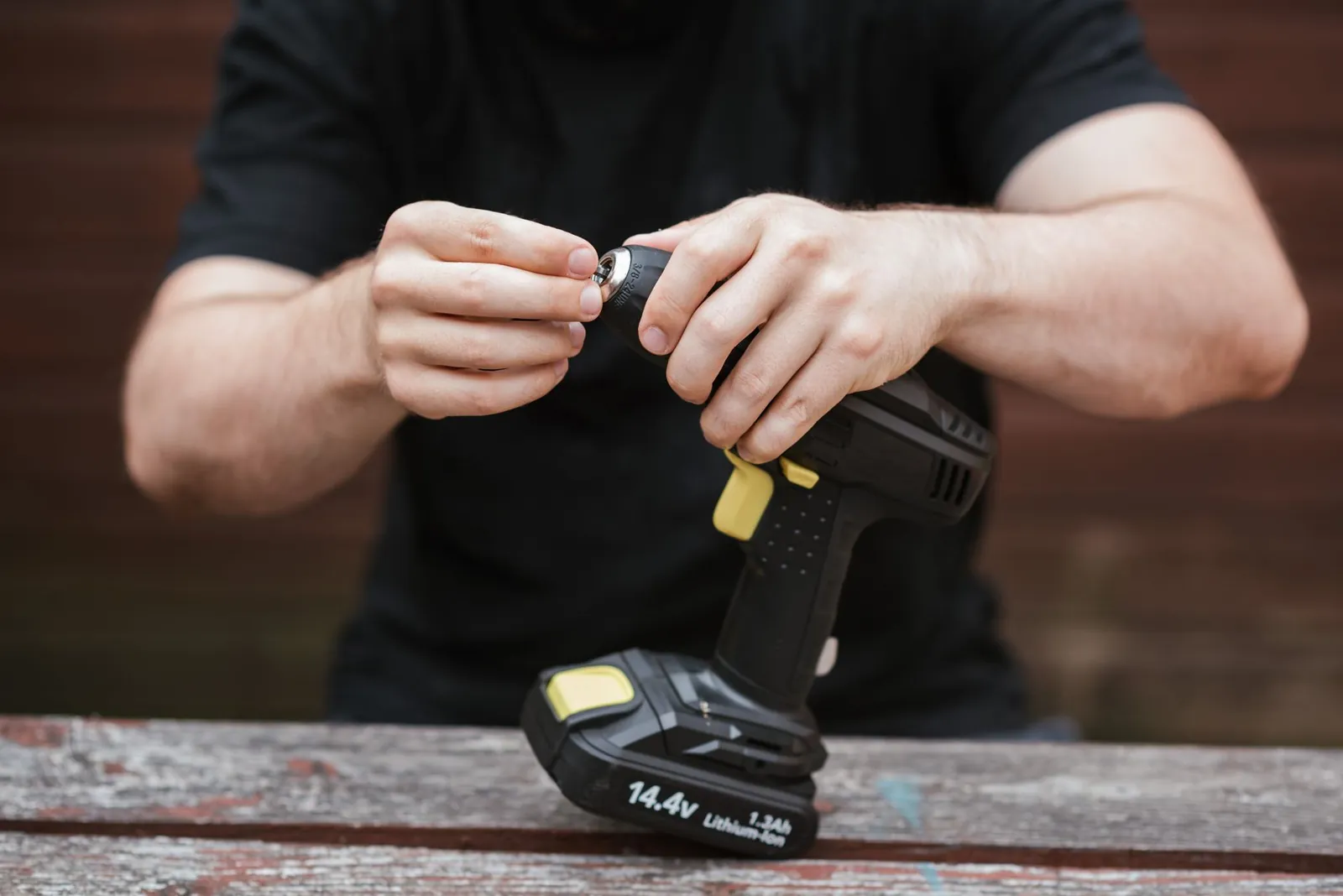
Modern 18-volt and 20-volt cordless drills produce 300 to 500 inch-pounds of torque—enough for most repairs and renovations. The catch is voltage sag: as the battery drains, performance drops noticeably on tough materials. You’ll feel it most when driving long screws into hardwood near the end of a charge cycle.
When raw power matters
Drilling into masonry, mixing a bucket of thinset, or running dozens of lag bolts through framing lumber—these tasks drain a cordless battery fast and work the motor hard. A corded drill handles them without complaint. A cordless drill can manage, but you’ll burn through charges and push the tool harder than it prefers.
Battery Runtime and Charging
A 2.0 Ah battery gives roughly 30 to 45 minutes of mixed use—drilling, driving, and idle time combined. A 4.0 Ah battery stretches that to 60 to 90 minutes. For a full day of deck building or cabinet installation, two batteries are the practical minimum so one charges while you work.
Fast chargers refill a battery in 30 minutes; standard chargers take up to two hours. If your drill came with only one battery and a slow charger, budget $100 to $200 for a second battery and a fast charger—it changes how the tool feels to use.
A corded drill has none of that math. Plug it in and work all day. On long renovation jobs, that simplicity is genuinely valuable.
Real-world runtime by task
- Light duty (hanging shelves, assembling flat-pack furniture): One charge covers 2 to 3 hours of actual work.
- Medium duty (deck building, cabinet installation): Two batteries keep you going most of a day.
- Heavy duty (framing, concrete anchors): Corded is more practical; cordless requires frequent swaps that break your rhythm.
Cost: Upfront and Over Time
A basic corded drill costs $40 to $80 and rarely needs replacing. No battery chemistry to degrade, no charging circuit to fail—just a motor and a cord. A decent corded drill bought today could still be running in 20 years.
Cordless drills range from $60 for a basic 18-volt brushed model to $200-plus for a premium 20-volt brushless kit with two batteries and a fast charger. Batteries degrade over time regardless of use, and replacement packs run $50 to $150 depending on capacity and brand. Over 10 years, battery replacements alone can add $150 to $300 to the total cost of ownership.
If you drill infrequently—a few times a year—that long-term cost is spread thin and cordless still wins on convenience. If you’re drilling weekly for years, a corded drill is the cheaper tool by a significant margin.
Buy cordless if you value convenience; buy corded if you value simplicity and raw power.
Portability and Convenience
No outlet hunting, no extension cord tangles, no tripping hazard on a ladder—cordless drills remove all of that. Working in the attic, up on scaffolding, or 40 feet from the nearest outlet becomes a non-issue. This is why most homeowners reach for cordless without a second thought.
Corded drills are tethered by definition. A 25-foot extension cord handles most garage and workshop situations, but outdoors or under a deck it becomes a snag risk. The cord also adds setup time that compounds across a long project.
For stationary bench work or a dedicated workshop, the cord is a minor inconvenience. For anything mobile, cordless wins by a wide margin.
Noise and Vibration
Corded drills run louder—typically 80 to 85 decibels—because they hit full power instantly and run at higher sustained RPMs. Cordless drills, especially brushless models, come in around 75 to 80 decibels. That 5 dB difference is noticeable in a quiet neighborhood on a Saturday morning. Brushless cordless drills also ramp up gradually rather than jumping to full speed, which makes them feel smoother in hand on delicate work.
Durability and Maintenance
Corded drills are straightforward to maintain: keep the vents clear of sawdust, store them dry, and they’ll outlast most other tools in your garage. The design hasn’t changed much in decades because it doesn’t need to.
Cordless drills are more complex. Lithium-ion batteries lose capacity even when sitting unused—expect about 80% capacity after three years of regular use, dropping to 60% by year five. The charger can fail, and the drill’s electronics are more vulnerable to hard drops or moisture than a corded motor. That said, a brushless cordless drill from a reputable brand—DeWalt, Milwaukee, Makita—should give you 7 to 10 years of reliable home use before anything needs replacing.
Comparison Table
| Factor | Cordless Drill | Corded Drill |
|---|---|---|
| Upfront cost | $60–$200 | $40–$80 |
| Power (torque) | 300–500 in-lbs | 300–600 in-lbs |
| Runtime | 30–90 min per charge | Unlimited |
| Portability | Excellent | Limited by cord |
| Noise level | 75–80 dB | 80–85 dB |
| Maintenance | Battery replacement needed | Minimal |
| Best for | Home repair, light to medium work | Heavy work, sustained drilling |
Our verdict
For a typical homeowner doing occasional repairs, furniture assembly, and weekend renovation projects, a cordless drill is the right tool—the convenience alone is worth the premium. If you frequently tackle heavy work like framing, concrete anchors, or sustained fastening, a corded drill is more practical and cheaper over a decade of ownership. Many experienced DIYers keep one of each: cordless for quick jobs and portability, corded for power and endurance on long days.
If you’re shopping for your first cordless drill, check out our guide to the best cordless drills for home use to narrow down the options by budget and battery platform.
Frequently asked questions
Can a cordless drill do everything a corded drill does?
Almost. Cordless drills handle most home tasks—drilling, driving, light mixing. Where they fall short is sustained heavy work: drilling dozens of holes through thick hardwood, or mixing large batches of mortar. Battery drain accelerates under load, and performance drops in ways a corded drill simply doesn’t experience. For occasional use, cordless is fine; for heavy or repetitive work, corded is more reliable.
How long do cordless drill batteries last?
Lithium-ion batteries typically retain about 80% capacity after three years and around 60% after five, depending on how often you use and charge them. Storing a battery fully charged or in a hot garage speeds that degradation. Most people replace batteries every 3 to 5 years at a cost of $50 to $150 depending on voltage and capacity.
Is a brushless cordless drill worth the extra cost?
Yes, if you drill regularly. Brushless motors run 20 to 30% more efficiently, generate less heat, and last longer than brushed motors. They cost $30 to $60 more upfront but extend battery life per charge and reduce long-term replacement costs. For occasional use—a few times a year—a brushed drill is perfectly adequate.
Can I use a corded drill outdoors?
Yes, with the right setup: a heavy-duty outdoor extension cord rated for wet conditions and a GFCI outlet. That said, cordless is safer outdoors—no electrocution risk, no cord to trip over on uneven ground. If you’re regularly working on a deck, in the yard, or anywhere far from a covered outlet, cordless is the smarter choice.
Do I need both a cordless and corded drill?
Not unless you’re a contractor or a serious DIYer who regularly tackles framing, concrete work, or other sustained heavy tasks. A good cordless drill handles the vast majority of home projects. Add a corded drill only when battery life becomes a genuine constraint on the work you actually do—not the work you imagine doing.

Ellen has renovated three houses, killed more seedlings than she admits, and writes about both.