This article may contain affiliate links. If you buy through them we may earn a commission at no extra cost to you.
For a yard under 0.5 acres, a robot mower in the $450–$800 range will handle your grass with zero input beyond initial setup. The models that earn their keep on small properties share three traits: a cutting deck narrow enough to fit through a standard 24-inch gate, reliable boundary navigation, and automatic docking so they charge and resume without you watching. Below I’ll cover what to look for, which mowers I’d actually buy, and what the real running costs look like.
Why Small Yards Are the Sweet Spot for Robot Mowers
A 0.25-acre yard takes 30–45 minutes to mow by hand, repeated 25–30 times a season—call it 15 hours a year. A robot mower running three times a week at night reclaims all of that. You also avoid the higher-end models ($2,000+) that large properties require; a $600 mower covers 0.3 acres reliably, and basic features like rain sensors, automatic docking, and perimeter navigation are sufficient when the lawn is simple and relatively flat.
The cost math works, too. Entry-level wire-based models start around $450. GPS models with app control start closer to $600. Neither requires professional installation if your yard is a straightforward shape.

Key Features to Prioritize
Cutting Width and Deck Size
A cutting width of 6–8 inches is standard for small-yard models and genuinely efficient on tight spaces. Wider decks (9–10 inches) don’t save meaningful time on a quarter-acre lawn and make it harder to navigate between fence posts or through garden gates. If you have a 24-inch gate, a 7-inch-deck mower clears it with room to spare; a 10-inch deck does not.
Navigation and Boundary Setup
Two systems dominate the market:
- Perimeter wire: You pin or bury a boundary cable around your lawn’s edge. Setup takes 1–2 hours for a 0.25-acre yard. Reliable in any weather, works under tree cover, costs nothing extra.
- GPS/app-based: No cable needed. You draw your lawn’s boundary in an app. Setup takes about 30 minutes, and repositioning later is easy—but dense tree canopy can degrade signal and cause the mower to drift a few inches off course.
For most small yards, either works. Choose wire if your lawn shape is fixed and you want maximum reliability. Choose GPS if you rearrange garden beds seasonally or want app-based scheduling and zone control.
Battery Life and Charging
Most small-yard models run 60–90 minutes per charge, covering 0.2–0.4 acres per cycle before docking automatically. They recharge in 1–2 hours and resume mowing. On a 0.25-acre yard, the mower might dock and recharge 2–3 times on a heavy mowing day—none of it requires your attention.
Lithium batteries (standard on models $500 and up) typically last 3–5 years. Lead-acid versions on cheaper models need replacement every 2–3 years at a cost of $150–$300. On a small yard where the mower rarely pushes its runtime limits, either is acceptable, but lithium is the better long-term value.
Weather Resistance and Sensors
Rain sensors pause mowing when grass is wet, preventing clumping and soil compaction. Cliff sensors stop the mower before it reaches a drop-off or retaining wall edge. Both are standard on any model over $400. If your yard has even a modest slope or an unfenced drop at the edge, don’t skip these.
Top Robot Mowers for Small Yards
| Model | Price | Cutting Width | Max Area | Navigation | Best For |
|---|---|---|---|---|---|
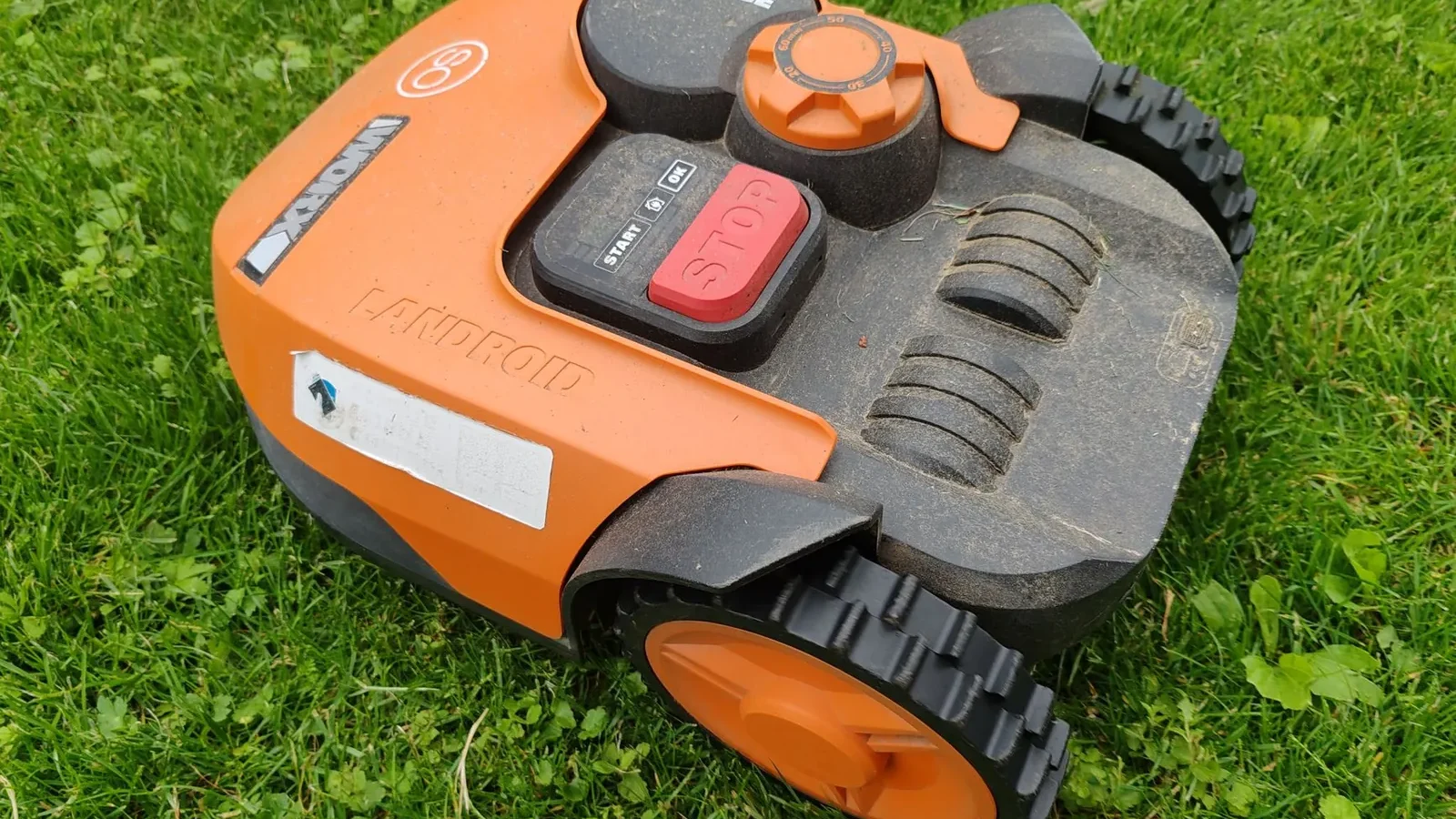
| Worx Landroid S WR130 | $450–$550 | 7 in | 0.25 acres | Wire boundary | Budget-conscious buyers, simple yards |
| Ecovacs Goat G1-800 | $599–$699 | 8 in | 0.3 acres | GPS + app | Tech-savvy owners, app control |
| Husqvarna Automower 105 | $799–$899 | 8.3 in | 0.25 acres | Wire boundary | Premium build quality, reliability |
| Ryobi RY48110 | $1,099–$1,199 | 20 in | 0.5 acres | GPS + app | Larger small yards, existing Ryobi battery users |
Our verdict
The Worx Landroid S is the best value for yards under 0.25 acres with simple layouts. If you want app control and GPS navigation, the Ecovacs Goat G1-800 delivers solid performance at a mid-range price. For reliability and strong dealer support, the Husqvarna Automower 105 justifies its premium. Choose the Ryobi if you already own Ryobi 40V batteries and your yard is closer to 0.5 acres.
Installation and Setup
Wire-based setup means mapping your lawn’s perimeter, then either pinning the cable above ground with plastic stakes or burying it 2–4 inches deep. Above-ground pinning is faster and easier to adjust; buried wire is invisible and won’t shift if you run a trimmer along the edge. Either way, plan on 1–2 hours for a quarter-acre yard with a straightforward shape.
GPS mowers skip the cable entirely. Download the app, walk your lawn’s perimeter while the app records it, then mark any no-mow zones—garden beds, patios, the area around the trampoline. Setup runs about 30 minutes, but if you have large trees, test the boundary accuracy before you trust it unsupervised.
Wherever you set the docking station, it needs a level surface, shade (direct sun degrades the charging contacts faster), and a power outlet within reach. Wipe the charging contacts monthly with a dry cloth to prevent connection failures.
Maintenance and Running Costs
Blade maintenance is the main recurring task. Cutting blades—usually small replaceable discs—dull after 4–8 weeks of regular use. Replacement sets cost $15–$40 depending on the model. Check the wire monthly for cuts from edging tools or garden forks; a damaged wire causes the mower to stop and throw an error until you splice or replace the break.
Electricity costs are negligible: a small robot mower draws roughly 5–10 kWh per month, about $1–$2 at average US rates. Battery replacement, when it comes, runs $150–$300 and happens every 3–5 years on a lithium model.
A robot mower works best on a consistent schedule—run it three times weekly rather than once a week—because it cuts only a little grass each time, leaving clippings fine enough to feed the soil rather than clump on top of it.
Those fine clippings mulch back into the lawn, returning nitrogen to the soil and reducing how often you need to fertilize. Pair this with a basic lawn care schedule to keep mowing height matched to your grass type through the season.
Common Challenges and Honest Trade-offs
Edge Finishing
Robot mowers miss a 2–4-inch strip along garden beds, fences, and hard edges. A string trimmer pass every 2–3 weeks handles this in under 10 minutes on a small yard. Some owners accept the rough margin; others find it the only part of the trade-off that bothers them.
Slopes
Most models handle slopes up to 35 degrees, but traction and straight-line tracking degrade before you hit that limit. If your yard has a significant grade, check user reviews for your specific model on similar terrain—manufacturer slope ratings are measured under ideal conditions.
Obstacles and Tight Passages
Robot mowers navigate around trees and stationary garden beds, but low-hanging branches (under 12 inches), garden hoses left out, and passages narrower than the mower’s body will stop progress or cause the unit to get stuck. A quick pre-mow scan of the lawn takes two minutes and prevents most jams.
Robot Mower vs. Push Mower: The Real Cost Comparison
A mid-range robot mower costs $600–$800 upfront. A decent self-propelled gas push mower costs $350–$500, plus roughly $60–$80 per year in fuel, oil changes, and blade sharpening. Add 15–20 hours of your time per season—valued at whatever your time is worth—and the push mower’s five-year total climbs well past the robot mower’s $800–$1,300 (purchase plus electricity and blades).
The financial case is strongest if you dislike mowing or have a schedule that makes 30-minute weekly sessions hard to fit in. If you genuinely enjoy the work or your lawn is under 1,500 square feet, a push mower is simpler and cheaper with no caveats.
Frequently asked questions
Do robot mowers work in the rain?
Most have rain sensors that pause mowing when grass is wet. Wet clippings clump and can clog the deck, and repeated wet-ground passes compact soil over time. Some owners disable the sensor for light drizzle, but the sensor earns its keep on heavier rain days.
How often do I need to charge the battery?
You don’t—the mower docks and charges automatically when the battery drops to around 20%, then resumes mowing. On a 0.25-acre yard during peak season, it might dock and recharge 2–4 times per active mowing day without any input from you.
Can a robot mower handle multiple lawn sections?
Wire-based mowers can cover disconnected sections with separate boundary loops, but the setup is more involved. GPS models handle multiple zones more cleanly through the app. For most small yards with a single contiguous lawn, this isn’t a factor.
What’s the warranty on robot mowers?
Most brands cover parts and labor for 2–3 years. Batteries are typically covered for 1–2 years separately. Husqvarna’s dealer network makes warranty service easier to access than brands sold only online—worth factoring in if you’re spending $800 or more.
Will a robot mower damage my lawn?
Not if you run it on a regular schedule. At under 20 pounds, these mowers don’t compact soil the way foot traffic or heavy equipment does, and mulching fine clippings back into the turf improves soil health over time. The one risk is cutting too infrequently and letting grass get long—the mower then cuts more than a third of the blade at once, which stresses the turf.

Rob is a former carpenter who now explains home repairs so you only have to do them once.